Converting Tons to Cubic Yards for Road Base & Aggregates
One of the most confusing hurdles when planning an earthwork or paving project is the disconnect between how contractors measure volume and how quarries bill material:
- You measure your jobsite in feet, inches, and cubic yards (yd³).
- Quarries and aggregate suppliers weigh haul trucks and bill on scale tickets in tons (2,000 lbs) or metric tonnes (1,000 kg).
Because different rocks have radically different mineral densities, 1 cubic yard of aggregate DOES NOT equal 1 ton.
In this comprehensive guide, we provide the exact engineering conversion formulas, material density charts, and field rules of thumb.
1. The Physics of Density: Why 1 Yard ≠ 1 Ton
A cubic yard is a 3-dimensional unit of volume (3 ft × 3 ft × 3 ft = 27 cubic feet). A ton is a unit of mass (2,000 lbs).
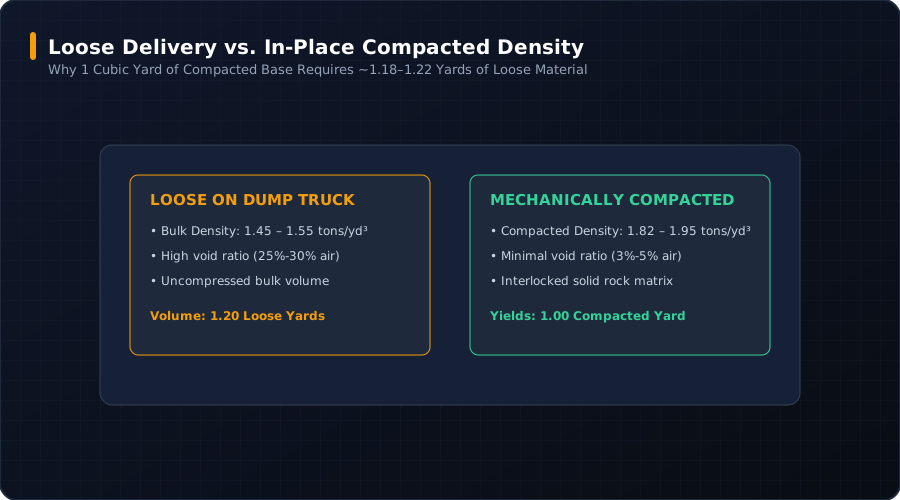
Dense graded aggregates (like Crusher Run and ABC Stone) contain both coarse angular gravel and finely pulverized stone dust. The stone dust fills the empty spaces between the larger stones, making road base significantly heavier than topsoil, mulch, or clean washed stone.
2. The Master Conversion Formulas
Formula 1: Converting Cubic Yards to Tons
Tons = [Cubic Yards × Material Density (lbs/cu ft) × 27] ÷ 2,000Or using density in tons/cu yd directly:
Tons = Cubic Yards × Material Density Factor (tons/cu yd)Formula 2: Converting Tons to Cubic Yards
Cubic Yards = (Tons × 2,000) ÷ [Material Density (lbs/cu ft) × 27]Formula 3: Calculating Compacted Volume from Dimensions
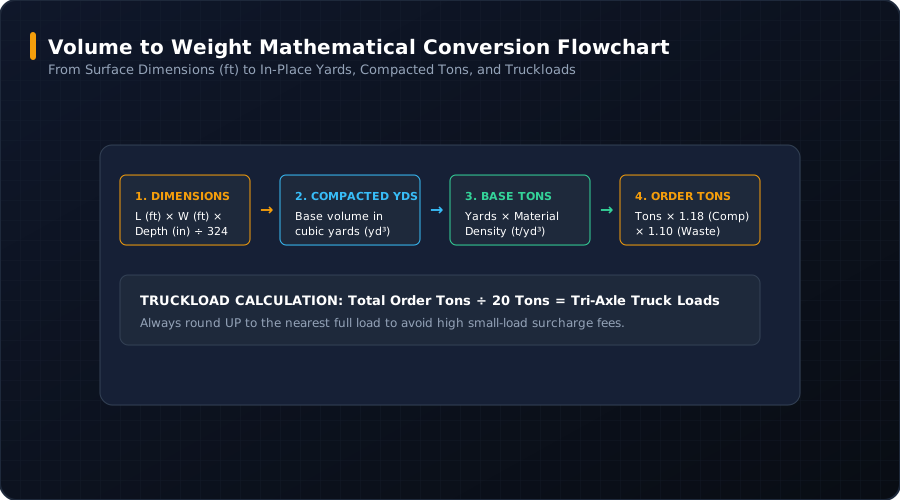
Compacted Cubic Yards = [Length (ft) × Width (ft) × Compacted Depth (in)] ÷ 3243. Master Density & Conversion Chart by Aggregate Type
The table below lists standard bulk unit weights, conversion multipliers, and volume yields for 12 major civil aggregate products:
| Aggregate Material Type | Bulk Density (lbs/cu ft) | Density (Tons / Cu Yd) | Yield (Cu Yds per 1 Ton) | Coverage @ 4” Depth (Sq Ft per Ton) |
|---|---|---|---|---|
| Crusher Run / DGA (3/4” Minus) | 135 – 145 lbs/ft³ | 1.82 – 1.95 tons/yd³ | 0.51 – 0.55 yd³/ton | 41 – 44 sq ft / ton |
| ABC Stone (DOT Specification) | 140 – 148 lbs/ft³ | 1.89 – 2.00 tons/yd³ | 0.50 – 0.53 yd³/ton | 40 – 43 sq ft / ton |
| Crushed Limestone (Clean #57 / 3/4”) | 105 – 115 lbs/ft³ | 1.42 – 1.55 tons/yd³ | 0.65 – 0.70 yd³/ton | 52 – 57 sq ft / ton |
| Caliche Base (TxDOT Item 247) | 125 – 135 lbs/ft³ | 1.68 – 1.82 tons/yd³ | 0.55 – 0.59 yd³/ton | 44 – 48 sq ft / ton |
| Recycled Concrete Base (RCA) | 122 – 132 lbs/ft³ | 1.65 – 1.78 tons/yd³ | 0.56 – 0.61 yd³/ton | 45 – 49 sq ft / ton |
| Crushed Granite Base | 145 – 155 lbs/ft³ | 1.95 – 2.09 tons/yd³ | 0.48 – 0.51 yd³/ton | 38 – 41 sq ft / ton |
| Decomposed Granite (DG) | 130 – 140 lbs/ft³ | 1.75 – 1.89 tons/yd³ | 0.53 – 0.57 yd³/ton | 42 – 46 sq ft / ton |
| Pea Gravel (Clean 3/8”) | 100 – 110 lbs/ft³ | 1.35 – 1.48 tons/yd³ | 0.67 – 0.74 yd³/ton | 54 – 60 sq ft / ton |
| Concrete Sand (ASTM C33) | 110 – 120 lbs/ft³ | 1.48 – 1.62 tons/yd³ | 0.62 – 0.67 yd³/ton | 50 – 54 sq ft / ton |
| Screened Topsoil | 75 – 90 lbs/ft³ | 1.01 – 1.21 tons/yd³ | 0.82 – 0.99 yd³/ton | 66 – 80 sq ft / ton |
4. Real-World Calculation Walkthrough
Scenario:
You are building a parking pad measuring 60 feet long, 20 feet wide, and 6 inches deep using ABC Stone (density = 1.90 tons/yd³) with an 18% compaction shrinkage factor and 8% waste buffer.
Step 1: Calculate Compacted Volume
Volume = (60 ft × 20 ft × 6 in) / 324 = 7,200 / 324 = 22.22 Compacted Cubic YardsStep 2: Convert to Net Base Tonnage
Net Base Tonnage = 22.22 cu yd × 1.90 tons/cu yd = 42.22 Net TonsStep 3: Apply Compaction (+18%) and Waste (+8%) Multipliers
Total Order Tonnage = 42.22 × 1.18 × 1.08 = 53.80 Tons to OrderStep 4: Convert to Tri-Axle Dump Truck Loads
Truck Loads = 53.80 tons / 18 tons per truck = 2.99 → Order 3 Tri-Axle Loads (54 Tons)5. Summary Field Rules of Thumb
- For Crusher Run & Road Base: Multiply in-place cubic yards by 1.85 to estimate net tons.
- For Clean Drainage Gravel (#57): Multiply cubic yards by 1.45 to estimate tons.
- Always order 15% to 25% extra tonnage to account for compaction densification and excavation subgrade variations.
Run unlimited custom conversions with our Master Road Base Calculator or check compaction physics in our Optimum Moisture Content Guide.
Civil Estimating & Geotechnical Engineering Review
Peer-VerifiedFormulas, density conversions, and lift recommendations are modeled after AASHTO M147 (Materials for Aggregate and Soil-Aggregate Subbase) and ASTM C33/D2922 standards. Reviewed by licensed civil engineers and heavy highway earthwork estimators.
Material & Application Specific Calculators
Access dedicated estimating pages tailored to specific quarry materials, regional state specifications, and project foundations.