Compaction & Optimum Moisture Content (OMC) Explained
In civil earthwork engineering, compaction is the process of mechanically densifying soil or aggregate by eliminating air voids. However, many contractors and homeowners make the mistake of running a heavy compactor over bone-dry aggregate or, conversely, flooding the trench until it turns into soup.
Without the correct amount of water—known in geotechnical engineering as Optimum Moisture Content (OMC)—even a 10-ton vibratory drum roller will fail to achieve the required structural density.
1. The Physics of Soil Compaction: Why Water Matters
Water acts as a physical lubricant between individual angular stone particles.
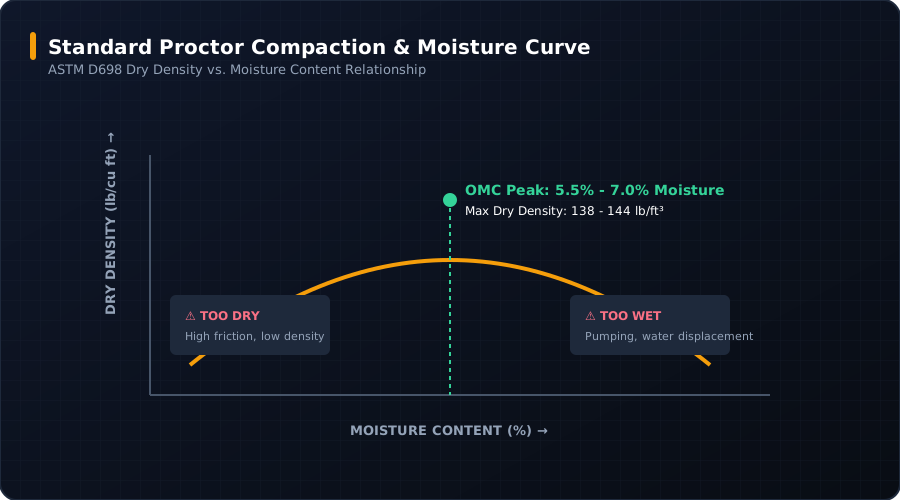
- When the aggregate is too dry: Particle-to-particle friction is extremely high. The stones resist shifting into a tight matrix, resulting in high air voids, low density, and future rutting.
- At Optimum Moisture Content (OMC): A thin film of water surrounds each aggregate particle. The lubricated particles slide effortlessly past one another under vibratory force, achieving maximum dry unit weight.
- When the aggregate is over-saturated (too wet): Water fills the pore spaces entirely. Because water is incompressible, hydrostatic pore pressure builds up under heavy compactor blows. The road base begins to “pump” and wave like rubber, preventing structural lock.
2. Standard vs. Modified Proctor Density (ASTM D698 vs. D1557)
Civil engineering specifications require road base compaction to be verified against laboratory Proctor standards:
| Test Standard | Energy Applied | Application | Typical Target Compaction |
|---|---|---|---|
| Standard Proctor (ASTM D698 / AASHTO T99) | 12,400 ft-lbf/ft³ (Light Drop Hammer) | Footpaths, patios, landscape berms | 95% – 98% of Max Dry Density |
| Modified Proctor (ASTM D1557 / AASHTO T180) | 56,250 ft-lbf/ft³ (Heavy 10-lb Hammer, 18” Drop) | Driveways, highway road base, parking lots | 95% – 100% of Max Dry Density |
For standard crushed limestone road base (such as Crusher Run or ABC Stone), Maximum Dry Density typically ranges from 138 to 146 lbs/cu ft, and Optimum Moisture Content falls between 5.5% and 7.5% by weight.
3. The Contractor’s “Hand Squeeze Ball Test”
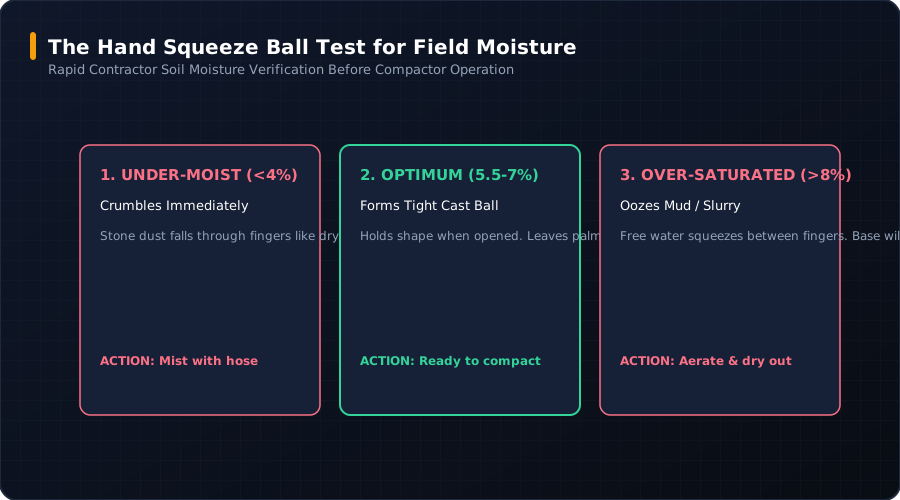
When you don’t have a nuclear density gauge or speedy moisture meter on site, experienced earthwork superintendents use the Hand Squeeze Ball Test to gauge moisture levels before starting the compactor:
How to Perform the Test:
- Dig down 2 to 3 inches into the spread aggregate lift.
- Grab a handful of road base containing both coarse chips and stone dust.
- Squeeze the material tightly into a ball in your fist, then open your fingers:
- Under-Moist (<4%): The ball crumbles apart immediately upon opening your hand. Dust blows in the wind. Remedy: Mist evenly with a garden hose or water truck spray bar.
- Optimum Moisture (5.5%–7%): The aggregate forms a tight, cohesive cast ball that holds together without cracking. Your palm feels cool and damp, but no free water drips off. Status: Ready for full compaction passes.
- Over-Saturated (>8%): Slurry or milky water squeezes between your knuckles. The ball deforms into sticky mud. Remedy: Allow to aerate in the sun or scarify with a grading rake to speed evaporation.
4. Lift Thickness: The 4-to-6 Inch Depth Rule
One of the most frequent compaction mistakes is attempting to compact a 10-inch or 12-inch layer of road base in a single pass.
Vibratory compaction energy dissipates exponentially with depth. A 4,000-lb plate compactor only achieves effective consolidation to a depth of approximately 3 to 4 inches. If you spread 8 inches of aggregate at once, only the top 3 inches will achieve 98% Proctor density—leaving the bottom 5 inches uncompacted and prone to deep wheel rutting over time.
The Multi-Lift Rule:
- For a 6-inch finished driveway: Install two 3-inch compacted lifts.
- For an 8-inch heavy RV pad: Install two 4-inch compacted lifts.
- For a 12-inch commercial base: Install three 4-inch compacted lifts.
5. Compactor Pass Protocol & Overlap
To ensure uniform density across the entire surface:
- First Pass (Seating): Operate the compactor at moderate speed in a straight longitudinal line along the lowest edge (shoulder), overlapping each track by 50%.
- Second & Third Passes (Densification): Execute parallel passes working from the outside edges inward toward the center crown.
- Final Cross-Hatch Passes (Finishing): Run the compactor perpendicular (at 90 degrees) to the driveway’s centerline to eliminate linear roller seams and lock the surface.
Explore our interactive Compaction Calculator to calculate volume shrinkage factors and required compactor passes for your aggregate type.
Civil Estimating & Geotechnical Engineering Review
Peer-VerifiedFormulas, density conversions, and lift recommendations are modeled after AASHTO M147 (Materials for Aggregate and Soil-Aggregate Subbase) and ASTM C33/D2922 standards. Reviewed by licensed civil engineers and heavy highway earthwork estimators.
Material & Application Specific Calculators
Access dedicated estimating pages tailored to specific quarry materials, regional state specifications, and project foundations.