Recycled Concrete Aggregate (RCA) as Road Base: Pros, Cons & Density
As natural aggregate supplies become increasingly constrained and landfill disposal fees rise, Recycled Concrete Aggregate (RCA)—also commonly referred to as Crushed Concrete Base, Concrete Road Base, or 21AA Recycled—has emerged as one of the most widely used base materials in modern civil engineering.
State Departments of Transportation (DOTs) across North America now permit RCA for sub-base and flexible pavement construction under standards such as AASHTO M319 (“Reclaimed Concrete Aggregate for Unbound Base”).
In this guide, we evaluate the engineering performance, compaction dynamics, cost benefits, and self-cementing properties of crushed concrete.
1. How Recycled Concrete Base is Produced
RCA is manufactured by processing clean demolished highway pavements, bridge decks, sidewalks, and building foundations through heavy impact crushers and multi-deck screening plants.
During the crushing process:
- Powerful cross-belt electromagnets extract steel rebar and wire mesh.
- Air classifiers remove light debris such as wood, insulation, and plastic.
- Screens size the material into a continuous dense-graded profile (typically 3/4-inch minus or 1.5-inch minus) with a balanced fraction of residual mortar dust.
2. The Self-Cementing Effect: Why RCA Gets Stronger Over Time
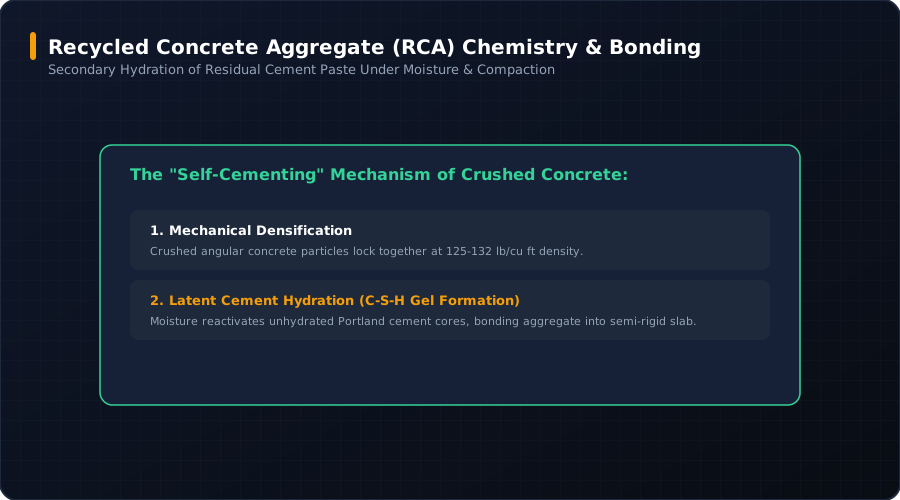
The most remarkable engineering property of RCA is its latent pozzolanic and self-cementing behavior.
When original structural concrete was cast, roughly 15% to 25% of the Portland cement grains never fully hydrated—their cores remained encapsulated inside the cured matrix. When demolition plants crush the concrete into road base, fresh fracture planes expose these unhydrated cement particles.
When the RCA is spread on a jobsite, moistened, and rolled:
- Water reactivates the exposed unhydrated cement grains.
- Secondary Calcium-Silicate-Hydrate (C-S-H) gels form across particle contact points.
- Over a 6-to-12-month period, the compacted RCA undergoes continuous in-situ curing, transforming from a flexible granular base into a high-stiffness, semi-rigid pavement slab.
3. RCA vs. Virgin Crushed Limestone: Head-to-Head Comparison
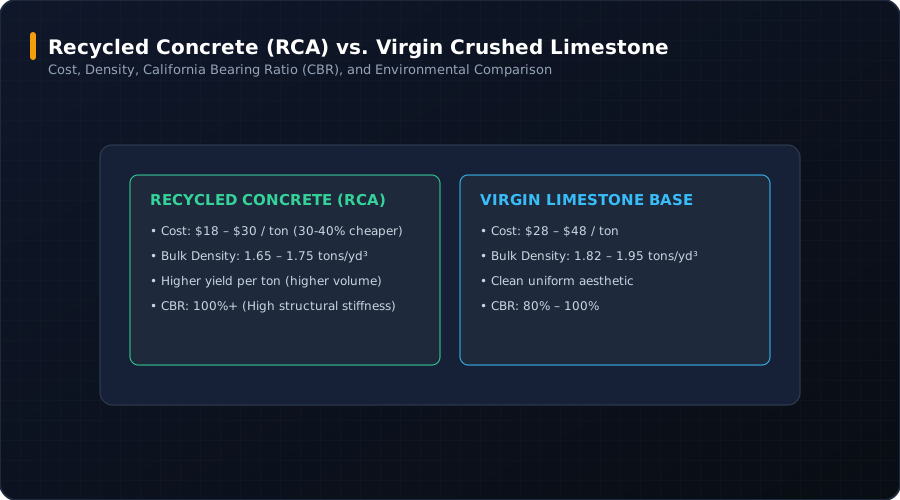
| Engineering Property | Recycled Concrete (RCA) | Virgin Crushed Limestone (ABC / DGA) |
|---|---|---|
| Material Cost per Ton | $16 – $28 / ton (30%–45% Savings) | $28 – $48 / ton |
| Bulk Loose Density | 1.35 – 1.45 tons/yd³ | 1.50 – 1.58 tons/yd³ |
| Compacted In-Place Density | 1.65 – 1.78 tons/yd³ | 1.82 – 1.95 tons/yd³ |
| California Bearing Ratio (CBR) | 100% – 140% (Superior Stiffness) | 80% – 100% |
| Tonnage Yield per Cubic Yard | ~10% to 15% Higher Volume per Ton | Standard yield |
| Optimum Moisture Content (OMC) | 9.0% – 12.5% | 5.5% – 7.5% |
| AASHTO / ASTM Standard | AASHTO M319 / ASTM D692 | AASHTO M147 / ASTM D2940 |
Financial Advantage: Because crushed concrete is significantly lighter (less dense) than solid virgin limestone rock, one ton of RCA yields roughly 12% to 15% more square footage of coverage at a given depth, compounding your total savings on both material price and freight.
4. Engineering Pros & Cons of Crushed Concrete
Major Advantages:
- Exceptional Structural Stability: Achieves higher California Bearing Ratio (CBR) and resilient modulus values than many virgin aggregates, resisting heavy truck rutting.
- Cost Savings: 30% to 50% cheaper than quarried virgin stone in urban centers.
- Environmental Benefits: Diverts thousands of tons of demolition waste from landfills and earns LEED project credits.
- High Frost Resistance: High internal friction angle prevents frost heave deformation.
Important Limitations:
- Higher Water Demand: The porous adhered mortar paste absorbs significant water, requiring careful moisture monitoring during compaction.
- Leaching of High-pH Water: Freshly compacted RCA runoff can reach a pH of 10 to 12. Avoid placing RCA directly adjacent to aluminum culverts or sensitive aquatic wetlands without geotextile filtration.
- Appearance: Contains gray concrete fragments and occasional flecks of brick or cured asphalt, making it less aesthetically pleasing than decorative white limestone as a top wearing surface.
5. Ideal Applications for Recycled Concrete Base
- Commercial Truck & RV Parking Pads: Withstands heavy static wheel loads without rutting.
- Under-Asphalt & Concrete Paving Sub-Base: Provides an unyielding structural platform for final hard surface paving.
- Farm & Construction Haul Roads: Highly durable, all-weather unpaved roadways.
- Shed & Detached Garage Foundations: Solid, frost-resistant gravel pads.
Estimate your project savings and required tonnage with our Recycled Road Base Calculator.
Civil Estimating & Geotechnical Engineering Review
Peer-VerifiedFormulas, density conversions, and lift recommendations are modeled after AASHTO M147 (Materials for Aggregate and Soil-Aggregate Subbase) and ASTM C33/D2922 standards. Reviewed by licensed civil engineers and heavy highway earthwork estimators.
Material & Application Specific Calculators
Access dedicated estimating pages tailored to specific quarry materials, regional state specifications, and project foundations.