How to Calculate Road Base for a Residential Driveway
Building a durable, rut-resistant gravel or paved driveway begins with an unyielding foundation. Civil engineers and heavy earthwork contractors know that over 90% of premature driveway failures—including deep ruts, potholes, and frost heaves—originate from an inadequate, poorly compacted road base layer, rather than surface defects.
Whether you are preparing a sub-base for asphalt, concrete, interlocking pavers, or a standalone crushed stone driveway, this guide provides the exact mathematical formulas, density conversions, and lift protocols used by civil highway estimators.
1. Driveway Layer Anatomy & Recommended Depths
A structural road base acts as a load-distribution platform. It spreads the concentrated weight of vehicle tires across a broader area of the weaker native subgrade soil beneath.

Recommended Compacted Depths by Vehicle Load
| Driveway Application | Compacted Depth | Minimum Lifts | Typical Base Material |
|---|---|---|---|
| Light Passenger Cars (Sedans & Small SUVs) | 4 – 5 inches (100–125 mm) | 1 – 2 lifts | Crusher Run (3/4” Minus), DGA |
| Standard Residential (Pickups & Delivery Vans) | 6 inches (150 mm) | 2 lifts (3” each) | ABC Stone, Crusher Run, Class 2 |
| Heavy Vehicles (RVs, Horse Trailers, Fire Trucks) | 8 – 10 inches (200–250 mm) | 2 – 3 lifts | 1.5” Base + 3/4” Choke Layer |
| Commercial / Agricultural Heavy Equipment | 10 – 12 inches (250–300 mm) | 3 – 4 lifts | Caltrans Class 2 / TxDOT Item 247 |
Pro Tip: For most residential driveways, 6 inches of mechanically compacted road base is the industry sweet spot. Attempting to build with only 2 to 3 inches will cause vehicle tires to punch through into the subgrade during spring thaw or heavy rainstorms.
2. The Master Volume Formula
To determine how much road base your driveway requires, first calculate the in-place compacted volume in cubic yards.
Compacted Volume (cu yd) = [Length (ft) × Width (ft) × Compacted Depth (in)] ÷ 324Note on the constant 324: Since 1 cubic yard = 27 cubic feet, and 1 foot = 12 inches, 27 × 12 = 324.
Example Calculation:
For a standard residential driveway measuring 100 feet long, 12 feet wide, and 6 inches deep:
Volume = (100 ft × 12 ft × 6 in) / 324 = 7,200 / 324 = 22.22 Compacted Cubic YardsUse our interactive Driveway Base Calculator to compute non-rectangular geometries, flared entrances, and turnaround loops automatically.
3. Converting Volume to Quarry Tonnage (Density Factor)
Quarries and aggregate suppliers sell road base by the ton (2,000 lbs) or metric tonne (1,000 kg), not by the cubic yard. Because dense graded aggregates contain both coarse rock and finely crushed stone dust, their bulk density is significantly higher than clean gravel or topsoil.
| Material Preset | In-Place Compacted Density | Loose Delivered Density |
|---|---|---|
| Crusher Run / DGA (3/4” Minus) | 1.82 – 1.95 tons/yd³ (135–145 lb/ft³) | 1.50 – 1.58 tons/yd³ |
| ABC Stone / 21A / 21B | 1.89 – 1.98 tons/yd³ (140–147 lb/ft³) | 1.55 – 1.62 tons/yd³ |
| Caliche Base (TxDOT Item 247) | 1.70 – 1.85 tons/yd³ (126–137 lb/ft³) | 1.40 – 1.48 tons/yd³ |
| Recycled Concrete Aggregate (RCA) | 1.65 – 1.78 tons/yd³ (122–132 lb/ft³) | 1.35 – 1.45 tons/yd³ |
For standard Crusher Run at 1.85 tons per cubic yard:
Net Solid Tonnage = 22.22 cu yd × 1.85 tons/yd³ = 41.11 Base Tons4. Compaction Shrinkage & Excavation Waste Buffer
Loose stone delivered on a dump truck contains 18% to 22% air voids. When placed on the driveway and rolled with a vibratory compactor, the particles interlock, squeezing out air and causing the volume to shrink.
Furthermore, uneven excavation, soft subgrade sinkage, and edge spill require a 5% to 10% waste buffer.
The Final Order Formula:
Total Tons to Order = Net Base Tons × (1 + Compaction Factor) × (1 + Waste Factor)
Total Tons to Order = 41.11 tons × 1.20 × 1.08 = 53.28 Tons
Warning: Never skip the compaction multiplier! If you order only the nominal geometry tonnage (41.1 tons), your finished driveway will end up only 4.5 inches thick instead of the planned 6 inches.
5. Dump Truck Hauling Logistics
Aggregate trucking costs represent a significant portion of your material budget. Hauling is typically billed per ton or by the hour with a minimum load threshold.
| Dump Truck Configuration | Maximum Legal Payload | Average Capacity (Road Base) | Loads Needed for 54 Tons |
|---|---|---|---|
| Single Axle Dump | 5 – 7 Tons | ~3.5 – 4.5 cu yds | 8 – 11 trips |
| Tandem Axle Dump (6-Wheeler) | 12 – 15 Tons | ~8 – 10 cu yds | 4 trips |
| Tri-Axle Dump (Standard) | 18 – 22 Tons | ~12 – 15 cu yds | 3 trips |
| End Dump Semi-Trailer | 24 – 26 Tons | ~16 – 18 cu yds | 2 trips |
For our 53.28-ton example, ordering three full 18-ton Tri-Axle dump trucks (54 tons total) optimizes freight costs and leaves a small contingency for grading low spots.
6. Step-by-Step Installation Protocol
- Excavation & Subgrade Proof-Rolling: Excavate native topsoil down to stable mineral soil. Proof-roll the subgrade with a heavy truck or compactor to spot soft, spongy sections.
- Install Woven Geotextile Fabric: On clay or silty soils, lay a high-strength woven geotextile fabric (such as 200W). This prevents base aggregate from sinking into the subgrade mud.
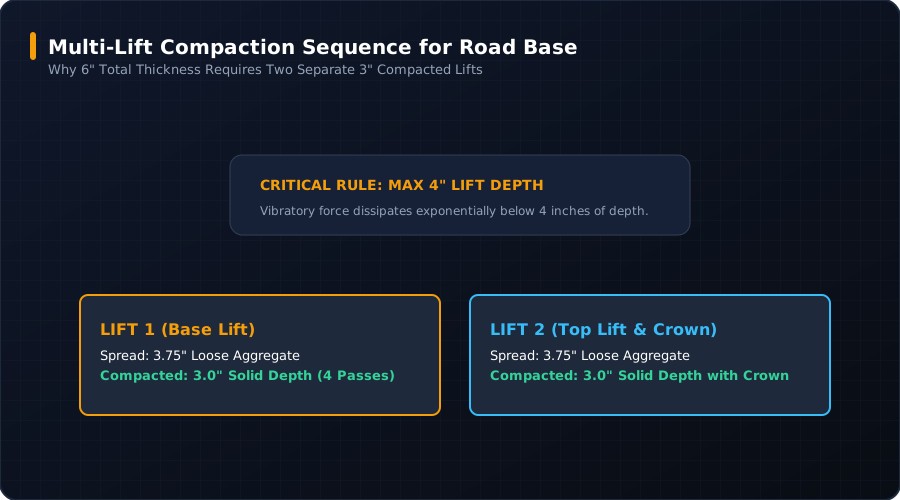
- Spread in 3-Inch Lifts: Never spread 6 inches of stone and attempt to compact it in one shot. Vibratory force cannot penetrate deeper than 4 inches effectively. Spread a 3.75-inch loose lift, compact down to 3 inches, then repeat with the second lift.
- Moisture Conditioning (Optimum Moisture Content): Lightly hose or spray the stone so it reaches roughly 5%–7% moisture. Dry stone dust cannot lubricate the coarse particles into maximum density.
- Shape a 1.5% to 2% Center Crown: Grade the center of the driveway 2 to 3 inches higher than the outer edges so rainwater sheds instantly into side ditches.
- Vibratory Compaction: Execute at least 4 to 6 passes with a 4,000+ lb vibratory plate compactor or 1.5-ton drum roller until the aggregate rings under steel without leaving tire impressions.
Quick Reference Driveway Material Chart
| Driveway Dimensions | Compacted Depth | Material (Crusher Run) | Tri-Axle Truckloads |
|---|---|---|---|
| 50 ft × 10 ft | 4 inches | 14.8 Tons | 1 truckload (small) |
| 50 ft × 12 ft | 6 inches | 26.6 Tons | 2 truckloads |
| 100 ft × 12 ft | 6 inches | 53.3 Tons | 3 truckloads |
| 150 ft × 12 ft | 6 inches | 80.0 Tons | 4 truckloads |
| 200 ft × 14 ft | 8 inches | 165.7 Tons | 8 truckloads |
Calculate your exact custom project requirements in seconds with our Master Road Base Calculator or explore regional specifications in our Crusher Run Calculator.
Civil Estimating & Geotechnical Engineering Review
Peer-VerifiedFormulas, density conversions, and lift recommendations are modeled after AASHTO M147 (Materials for Aggregate and Soil-Aggregate Subbase) and ASTM C33/D2922 standards. Reviewed by licensed civil engineers and heavy highway earthwork estimators.
Material & Application Specific Calculators
Access dedicated estimating pages tailored to specific quarry materials, regional state specifications, and project foundations.