Geotextile Fabric Under Road Base: Woven vs. Non-Woven Guide
Homeowners and contractors frequently encounter a frustrating phenomenon: they dump tons of expensive crushed stone on a soft driveway, and within six to twelve months, the gravel completely disappears into the underlying mud.
In geotechnical engineering, this failure is known as subgrade intrusion and aggregate contamination. Installing a high-strength geotextile fabric beneath your road base is the single most cost-effective insurance policy against premature pavement failure.
In this guide, we examine the physics of subgrade separation, compare woven vs. non-woven fabrics, and provide installation best practices.
1. Why Aggregate Disappears: The Physics of Mud Pumping
When heavy vehicle tires drive over an unpaved road on soft, saturated subgrade soil (such as wet clay or silt), two destructive forces occur simultaneously:
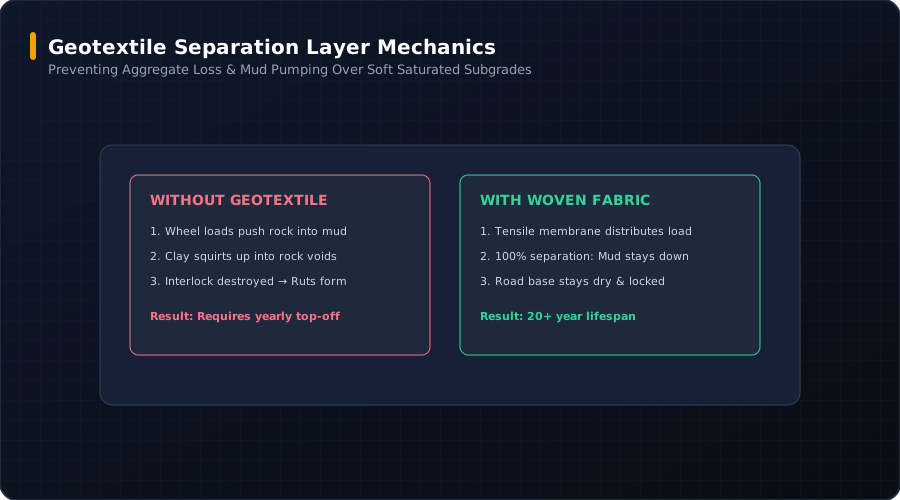
- Pore Pressure & Mud Injection: The concentrated downward wheel load creates intense hydrostatic pore pressure in the wet soil. Saturated clay slurry squirts upward through the voids of the gravel layer.
- Aggregate Punching: The angular gravel stones punch downward into the soft subgrade.
- Loss of Structural Interlock: Once clay infiltrates the stone matrix, particle-to-particle friction is destroyed. The road base loses its structural bearing capacity and turns into deep, impassable ruts.
The Geotextile Solution:
A geotextile fabric acts as a permanent, impenetrable separation and filtration membrane. It confines the road base above while keeping the native subgrade soil below, preserving 100% of the aggregate’s structural integrity.
2. Woven vs. Non-Woven Geotextiles: Which Do You Need?
A common mistake is buying thin, black landscape weed barrier from a garden center and expecting it to support a driveway. Weed barrier will tear on the very first dump truck pass. You must install an engineered civil geotextile.
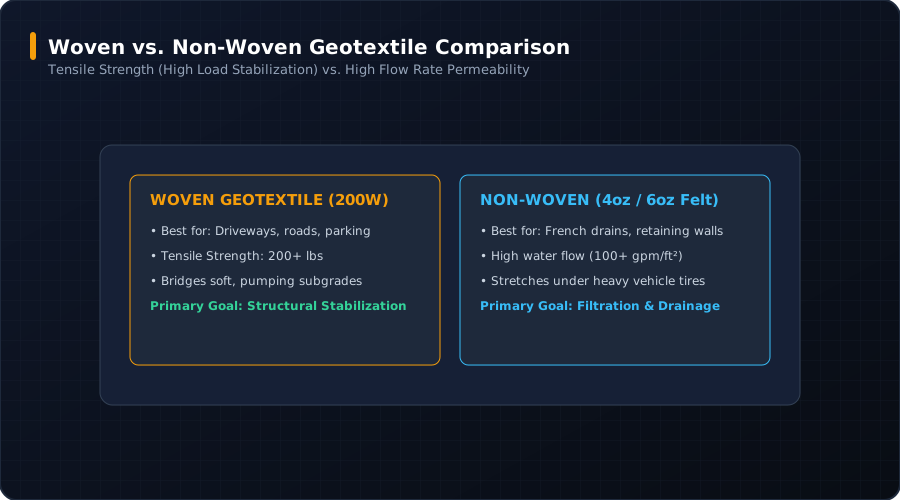
Comparison Table:
| Property | Woven Geotextile (e.g., 200W / Class 1) | Non-Woven Geotextile (e.g., 4oz / 6oz / 8oz) |
|---|---|---|
| Manufacturing Method | Slit-film polypropylene tapes woven in cross pattern | Needle-punched random synthetic fibers (felt-like) |
| Primary Engineering Function | Separation & Subgrade Stabilization | Drainage & Particle Filtration |
| Tensile Grab Strength | High (200 – 315 lbs / ASTM D4632) | Low to Moderate (100 – 205 lbs) |
| Elongation / Stretch Under Load | Low (<15%) — Bridges soft ruts firmly | High (50%+) — Stretches under heavy tires |
| Water Flow Rate (Permeability) | Moderate (4 – 12 gpm/ft²) | Extremely High (90 – 140 gpm/ft²) |
| Ideal Applications | Driveways, Roads, Parking Pads, Shed Bases | French Drains, Retaining Walls, Behind Gabions |
The Rule of Thumb:
- If your goal is load-bearing stabilization under road base, use Woven Geotextile (200W).
- If your goal is high-volume water drainage without clogging, use Non-Woven Geotextile.
3. How Geotextile Reduces Required Base Thickness
According to AASHTO road design standards, installing a high-modulus woven geotextile fabric over weak subgrades (CBR < 3) provides a “membrane action” (structural bridging).
By distributing wheel point loads over a 30% wider subgrade area:
- A driveway that would normally require 8 to 10 inches of crushed stone on bare clay can be safely built with only 6 inches of road base when placed on woven geotextile.
- The savings in reduced aggregate tonnage and hauling fees usually far exceed the cost of the fabric roll ($0.15 to $0.30 per square foot).
4. Step-by-Step Installation Best Practices
- Grade & Clear the Subgrade: Excavate sod and organic topsoil. Remove large exposed roots, tree stumps, and sharp boulders that could puncture the fabric during rolling.
- Roll Out Along Direction of Traffic: Roll the fabric lengthwise down the driveway. Keep the material taut and free of major wrinkles.
- Ensure Proper Seam Overlap:
- On firm soils (CBR > 3): Overlap adjacent rolls by at least 12 to 18 inches (30–45 cm).
- On soft, wet clay or peat (CBR < 2): Increase overlap to 24 to 36 inches (60–90 cm).
- Anchor with Sod Staples: Secure edges every 10 to 15 feet with 6-inch steel U-shaped ground staples to prevent the fabric from blowing in the wind during gravel delivery.
- Never Drive Equipment Directly on Bare Fabric: Always dump road base ahead of the truck and push the aggregate forward over the fabric using a skid-steer or dozer blade. Maintain a minimum 4-inch cushion of stone beneath machine tracks.
Calculate your exact square footage and road base requirements with our Master Road Base Calculator and explore drainage repair in our Muddy Driveway Guide.
Civil Estimating & Geotechnical Engineering Review
Peer-VerifiedFormulas, density conversions, and lift recommendations are modeled after AASHTO M147 (Materials for Aggregate and Soil-Aggregate Subbase) and ASTM C33/D2922 standards. Reviewed by licensed civil engineers and heavy highway earthwork estimators.
Material & Application Specific Calculators
Access dedicated estimating pages tailored to specific quarry materials, regional state specifications, and project foundations.