Dump Truck Capacity Classes: Single, Tandem, Tri-Axle & End Dumps

When purchasing road base, crushed stone, or gravel for a construction project, material pricing is only half the equation—hauling and trucking logistics often represent 30% to 50% of the total project invoice.
Understanding how dump truck classes operate, their legal payload capacities (dictated by Federal and State Bridge Weight Formulas), and jobsite accessibility requirements will help you avoid costly short-load surcharges, property damage, and scheduling delays.
1. Overview of Dump Truck Capacity Classes
Dump truck classifications are defined by the number of axles, Gross Vehicle Weight Rating (GVWR), and legal weight restrictions.
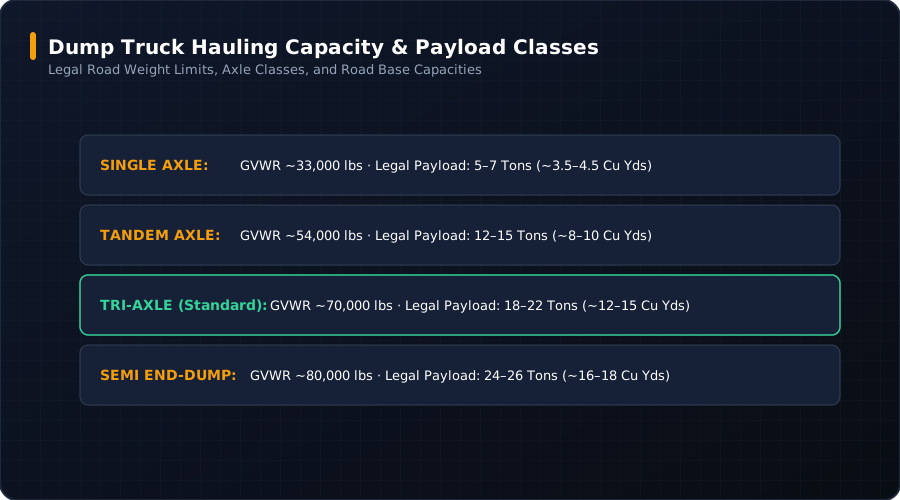
Summary Comparison Table
| Dump Truck Configuration | Axles | Typical Tare (Empty) Weight | Legal GVWR | Legal Road Base Payload (Tons) | Capacity in Cubic Yards (Road Base) |
|---|---|---|---|---|---|
| Single Axle (Class 6/7) | 2 | ~14,000 – 16,000 lbs | 33,000 lbs | 5 – 7 Tons | 3.0 – 4.5 cu yds |
| Tandem Axle (Class 8 / 6-Wheeler) | 3 | ~22,000 – 25,000 lbs | 54,000 lbs | 12 – 15 Tons | 8.0 – 10.0 cu yds |
| Tri-Axle (Standard Commercial) | 4 | ~26,000 – 29,000 lbs | 70,000 lbs | 18 – 22 Tons | 12.0 – 15.0 cu yds |
| Quad Axle / Superdump | 5 – 6 | ~30,000 – 34,000 lbs | 80,000 lbs | 22 – 26 Tons | 15.0 – 17.5 cu yds |
| Tractor-Trailer End Dump | 5 | ~32,000 – 36,000 lbs | 80,000 lbs | 24 – 26 Tons | 16.0 – 18.0 cu yds |
2. Deep-Dive by Truck Class
1. Single Axle Dump Trucks (5–7 Tons)
- Best for: Tight urban driveways, small residential landscaping, shed pad foundations, and alleyways where larger trucks cannot navigate.
- Pros: Highly maneuverable, light footprint causes minimal lawn or asphalt cracking.
- Cons: High delivery cost per ton. Delivery fees on small orders can exceed the cost of the aggregate itself.
2. Tandem Axle Dump Trucks (12–15 Tons)
- Best for: Medium residential driveway resurfacing, garage pads, and suburban projects.
- Pros: Capable of carrying full residential projects in a single trip while still fitting within standard 10-foot suburban driveways.
3. Tri-Axle Dump Trucks (18–22 Tons) — The Industry Standard
- Best for: New gravel driveway construction, commercial parking lots, sub-base installations, and heavy civil foundations.
- Pros: Most cost-effective delivery rate per ton for residential and light commercial work. Almost all aggregate quarries keep fleets of tri-axles on standby.
4. Tractor-Trailer End Dumps & Belly Dumps (24–26 Tons)
- Best for: Highway paving, municipal road projects, and large commercial subdivision earthwork.
- Cons: Requires massive turnaround space and cannot enter typical residential neighborhoods or cul-de-sacs.
3. Jobsite Clearance & Delivery Safety
Before the delivery truck arrives, verify that your jobsite meets the required vertical and horizontal clearance minimums:
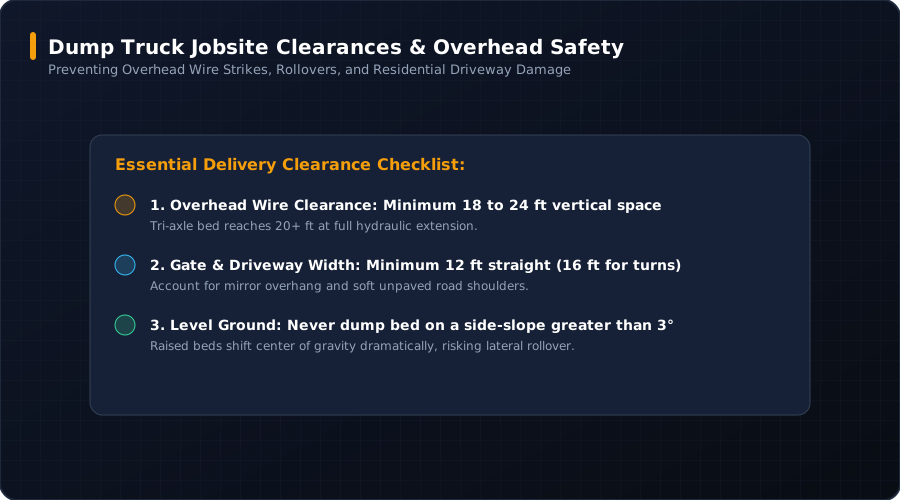
1. Overhead Clearance (Powerlines & Trees)
When a tri-axle dump bed raises to its maximum hydraulic angle (typically 45° to 50°), the top of the tailgate reaches 20 to 24 feet into the air.
Critical Safety Warning: Never allow a dump truck to tip aggregate under or near overhead electric power lines. Maintain a minimum 10-foot safety buffer from all power lines.
2. Roadway & Gate Widths
A standard commercial dump truck is 8.5 feet wide (excluding side mirrors). To enter safely without taking down fence posts or clipping gate hardware, ensure a minimum straight entrance width of 12 feet (or 16 feet if turning off a narrow rural road).
3. Ground Firmness & Rollover Prevention
Dump trucks carry tremendous weight on small tire contact patches. A fully loaded tri-axle exerts over 70,000 lbs of downward force. If one set of rear wheels sinks into soft mud or a septic drain field while the dump bed is fully elevated, the truck’s center of gravity shifts instantly, causing a catastrophic lateral rollover.
4. Tailgating vs. Pile Dumping
When placing road base, ask the driver if they can “tailgate” (spread dump) the aggregate:
- Tailgate Dumping: The driver cracks the tailgate chains to a 3-to-4-inch gap, raises the bed slightly, and drives forward slowly. This lays an even, 3-to-4-inch ribbon of road base directly along the driveway, saving hours of manual raking or skid-steer grading.
- Pile Dumping: The truck deposits the entire 20-ton payload into one large pile. Necessary under low-hanging tree canopies or on steep driveway grades.
Calculate the exact number of truckloads required for your project with our Road Base Calculator to streamline your delivery scheduling.
Civil Estimating & Geotechnical Engineering Review
Peer-VerifiedFormulas, density conversions, and lift recommendations are modeled after AASHTO M147 (Materials for Aggregate and Soil-Aggregate Subbase) and ASTM C33/D2922 standards. Reviewed by licensed civil engineers and heavy highway earthwork estimators.
Material & Application Specific Calculators
Access dedicated estimating pages tailored to specific quarry materials, regional state specifications, and project foundations.