Crusher Run vs. ABC Stone: Key Differences & Applications
When ordering aggregate for a new driveway, parking lot, or paver patio foundation, you will frequently hear suppliers and contractors recommend either Crusher Run or ABC Stone (Aggregate Base Course). While both materials belong to the broad family of dense-graded aggregates (DGA), subtle differences in gradation standards, quarry production methods, and state department of transportation (DOT) specifications dictate how each performs under heavy wheel loads.
In this guide, we break down particle size distribution, compaction behavior, drainage characteristics, and regional terminology to help you select the ideal road base material.
1. What is Crusher Run?
Crusher Run (also known as Dense Graded Aggregate / DGA, Quarry Process / QP, Crushed Run, or 3/4” Minus) is an unscreened or broadly graded quarry product produced by feeding raw blasted stone directly through primary and secondary jaw/cone crushers.
Key Characteristics of Crusher Run:
- Top Size: Typically 3/4-inch (19 mm) or 1.5-inch (37.5 mm) angular fractured stone.
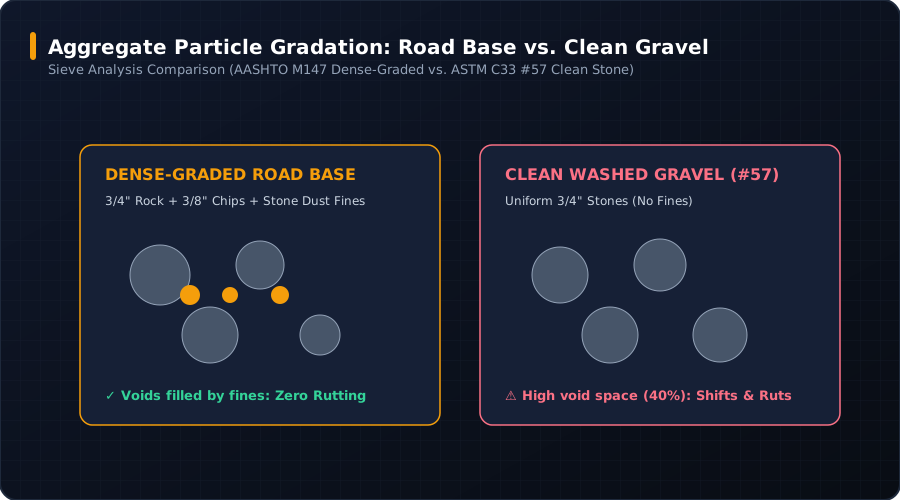
- Fines Content: High percentage of stone dust / mineral fines (passing the #200 sieve, often 8% to 15%).
- Compacted Density: 135 to 145 lbs/cu ft (1.82 to 1.95 tons/yd³).
- Surface Texture: Once compacted and moistened, the stone dust binds the angular aggregates into an almost concrete-hard, monolithic crust.
2. What is ABC Stone?
ABC Stone stands for Aggregate Base Course (often designated as VDOT 21A/21B, NCDOT ABC, Class 2 Aggregate Base, or Item 4 depending on your state).
Unlike commercial Crusher Run—which can vary somewhat between private quarry batches—ABC Stone is tightly engineered and screened to meet strict state highway DOT specifications (such as AASHTO M147 Grade A or B).
Key Characteristics of ABC Stone:
- Strict Sieve Control: Tight bands on the percentage of material passing the 1”, 3/4”, 1/2”, #4, #40, and #200 sieves.
- Controlled Plasticity: Plasticity Index (PI) is usually capped at 4 to 6 to prevent moisture-induced softening or freeze-thaw pumping.
- Compacted Density: 140 to 148 lbs/cu ft (1.89 to 2.00 tons/yd³).
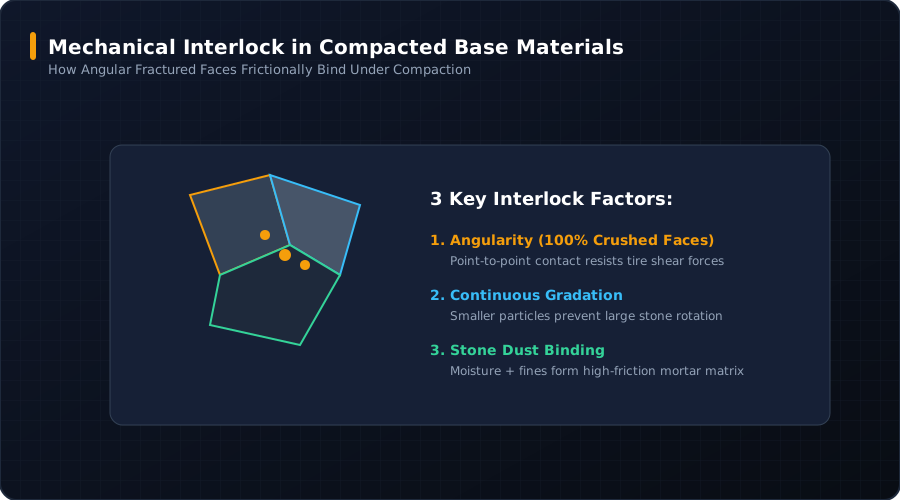
- 100% Crushed Faces: Ensures point-to-point mechanical interlock throughout the entire structural matrix.
3. Gradation & Specification Comparison
The table below contrasts standard commercial Crusher Run with engineered ABC Stone across standardized laboratory sieve screens:
| Sieve Size | Crusher Run (3/4” Minus) | State Spec ABC Stone (AASHTO M147) | Function in Matrix |
|---|---|---|---|
| 1.0 in (25.0 mm) | 100% Passing | 100% Passing | Eliminates oversized rocks that damage grading blades |
| 3/4 in (19.0 mm) | 90% – 100% Passing | 70% – 100% Passing | Primary structural load-bearing rock skeleton |
| 3/8 in (9.5 mm) | 50% – 80% Passing | 45% – 75% Passing | Intermediate particle bridging |
| No. 4 (4.75 mm) | 35% – 60% Passing | 30% – 60% Passing | Coarse sand fraction, locks aggregate voids |
| No. 40 (425 μm) | 15% – 35% Passing | 15% – 30% Passing | Fine sand binder |
| No. 200 (75 μm) | 5% – 15% (Stone Dust) | 4% – 10% (Tightly Capped) | Mineral filler / cohesive binding matrix |
4. Mechanical Interlock vs. Drainage Performance
Why Road Base Needs Stone Dust
Unlike clean drainage gravel (like #57 stone), which contains zero fines and leaves 40% empty void space, road base relies on its stone dust fraction to achieve mechanical interlock.
When vibrated with water at its Optimum Moisture Content (OMC), the fine stone particles lubricate the angular faces of the larger stones, allowing them to shift into maximum density. Once compacted, the stone dust fills every void, preventing the stones from shifting, rolling, or creating tire ruts.
Drainage Considerations:
- Crusher Run: Relatively low permeability. Water will shed off the crowned surface rather than percolate through. Excellent for unpaved farm roads and shedding surface runoff.
- ABC Stone: Controlled permeability. Designed to drain slightly faster while retaining 98% Modified Proctor density under heavy highway asphalt layers.
5. Applications: Which One Should You Choose?
| Project Type | Recommended Aggregate | Recommended Depth | Why? |
|---|---|---|---|
| Unpaved Gravel Driveway | Crusher Run (3/4” Minus) | 6 – 8 inches | Stone dust forms a tight, hard crust that resists loose stone displacement. |
| Under-Asphalt Driveway Base | ABC Stone (DOT Spec) | 6 – 8 inches | Meets asphalt paving compaction and plasticity requirements. |
| Interlocking Paver Patio / Walkway | Crusher Run or ABC | 4 – 6 inches | Provides an unyielding, flat sub-base for screeded bedding sand. |
| Heavy RV / Boat Parking Pad | ABC Stone (1.5” or 3/4”) | 8 – 10 inches | High California Bearing Ratio (CBR) prevents rutting under heavy static loads. |
| Barn / Horse Arena Foundation | Limestone Crusher Run | 4 – 6 inches | Smooth, compactable, non-abrasive when capped with sand. |
6. Regional Quarry Terminology & Sourcing
Quarry naming conventions vary by geographic market across North America:
- Mid-Atlantic & Southeast (VA, NC, SC, GA): Commonly sold as ABC Stone, 21A / 21B, or Crush and Run.
- Northeast (NY, NJ, PA, CT): Known as Quarry Process (QP), Dense Graded Aggregate (DGA), Item 4, or Dirty Stone.
- Midwest (OH, MI, IN, IL): Often designated as 304 Crushed Limestone, 21AA Aggregate, or Road Gravel.
- West Coast (CA, WA, OR): Specified as Caltrans Class 2 Base or 3/4” Aggregate Base (AB).
- Texas & Southwest: Referred to as TxDOT Item 247 Flexible Base or Caliche Road Base.
Calculate your exact quarry tonnage requirements with our dedicated Crusher Run Calculator or ABC Stone Calculator.
Civil Estimating & Geotechnical Engineering Review
Peer-VerifiedFormulas, density conversions, and lift recommendations are modeled after AASHTO M147 (Materials for Aggregate and Soil-Aggregate Subbase) and ASTM C33/D2922 standards. Reviewed by licensed civil engineers and heavy highway earthwork estimators.
Material & Application Specific Calculators
Access dedicated estimating pages tailored to specific quarry materials, regional state specifications, and project foundations.