Caliche Road Base: The Texas Highway Standard (TxDOT Item 247)
Across Central, South, and West Texas, as well as parts of New Mexico and Oklahoma, caliche is the undisputed backbone of regional road construction. From rural ranch roads and oilfield drilling pads to Texas Department of Transportation (TxDOT) secondary highways, caliche offers an economical, naturally cementitious flexible base.
In this technical guide, we examine the geological formation of caliche, TxDOT Item 247 engineering specifications, moisture requirements, and best installation practices for hot, semi-arid environments.
1. What is Caliche? Geological Origin & Chemistry
Caliche (pronounced kuh-lee-chee) is a sedimentary rock formed by the precipitation of calcium carbonate (CaCO3) within soil horizons in arid and semi-arid climates.
Unlike virgin crushed granite or basalt—which rely solely on geometric particle friction—caliche possesses a unique self-cementing chemical mechanism:
- When caliche is crushed, spread, and conditioned with water, fine calcium carbonate particles dissolve slightly into a mild slurry.
- Under high-energy compaction (pneumatic-tire or heavy vibratory rollers), the slurry fills microscopic voids between limestone fragments.
- As the base cures and dries under the Texas sun, the calcium carbonate recrystallizes, chemically cementing the aggregate into a dense, semi-rigid pavement crust.
2. TxDOT Item 247 Specification Grades
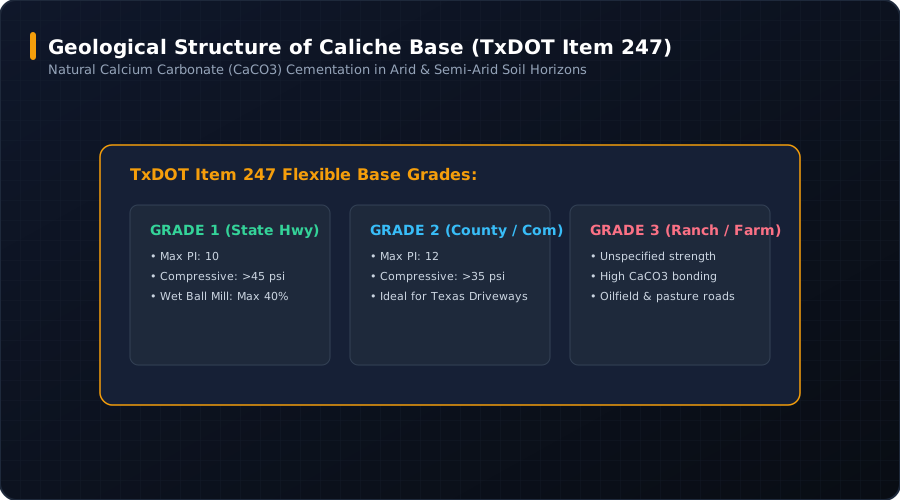
The Texas Department of Transportation governs flexible base materials under TxDOT Standard Specifications Item 247 (“Flexible Base”). It divides materials into specific Grades based on strength, plasticity, and durability:
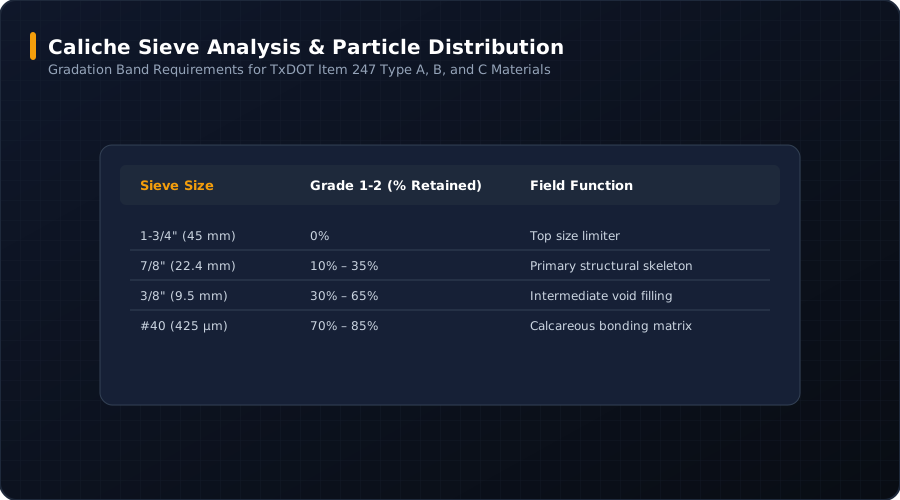
| TxDOT Specification Property | Grade 1-2 (Highway & Commercial) | Grade 3 (County & Ranch Road) | Grade 4 (Non-Spec / Private Driveway) |
|---|---|---|---|
| Master Sieve Top Size | 1-3/4 in (45 mm) Max | 1-3/4 in (45 mm) Max | Varies by pit |
| Retained on 7/8 in Sieve | 10% – 35% | 10% – 35% | Unregulated |
| Retained on #4 Sieve | 45% – 75% | 45% – 75% | Variable |
| Retained on #40 Sieve | 70% – 85% | 60% – 85% | Variable |
| Max Liquid Limit (LL) | 35 – 40 | 40 – 45 | None |
| Max Plasticity Index (PI) | Max 10 – 12 | Max 15 | None |
| Min Compressive Strength | 35 – 45 psi (at 0 psi lateral) | Not Specified | Pit-run |
| Wet Ball Mill Max Degradation | Max 40% – 45% | Max 50% | None |
Contractor Note: When ordering for a residential or commercial driveway, always request TxDOT Item 247 Grade 1 or Grade 2 Flexible Base. Grade 3 or uncertified “pit-run” caliche contains excessive unbonded plastic clay, which turns into slick, wheel-spinning mud during heavy Texas downpours.
3. Caliche Density, Moisture & Compaction Rules
Due to its chalky, porous nature, caliche has a lower unit weight than heavy crushed granite or basalt:
| Measurement Type | Caliche Base Density | Crushed Limestone Density | Crushed Granite Density |
|---|---|---|---|
| Loose Delivered Weight | 1.35 – 1.45 tons/yd³ | 1.50 – 1.58 tons/yd³ | 1.55 – 1.65 tons/yd³ |
| Compacted In-Place Density | 1.70 – 1.85 tons/yd³ | 1.82 – 1.95 tons/yd³ | 1.90 – 2.05 tons/yd³ |
| Bulk Dry Unit Weight | 125 – 135 lbs/cu ft | 135 – 145 lbs/cu ft | 140 – 150 lbs/cu ft |
| Optimum Moisture Content (OMC) | 8.0% – 12.0% | 5.5% – 7.5% | 4.5% – 6.5% |
Why Caliche Requires More Water
Because porous caliche aggregates absorb water internally into their calcium carbonate structure, they require a higher moisture content (8% to 12%) during rolling than standard limestone. If rolled dry, the surface will “dust out” and ravel quickly under tire traffic.
4. Caliche vs. Crushed Limestone: Pros and Cons
| Criteria | TxDOT Caliche Base | Crushed Limestone (Type D) |
|---|---|---|
| Quarry Material Cost | $12 – $22 per ton (Very affordable) | $26 – $42 per ton |
| Haul Distance in Central/West TX | Local pits within 15–25 miles | Rail-head or 50+ mile haul |
| Dry Weather Strength | Extremely high (bonds like concrete) | High (frictional interlock) |
| Wet Climate Performance | Moderate (vulnerable if unsealed) | Superior (low moisture sensitivity) |
| Dust Generation | Moderate to high (produces white dust) | Low to moderate |
5. Best Practices for Caliche Driveway Construction
- Subgrade Stabilization: In expansive black clay regions of Texas (such as the Houston/Austin I-35 corridor), install a heavy woven geotextile fabric beneath the caliche to prevent plastic clay intrusion.
- Build a 2% Drainage Crown: Water is caliche’s primary enemy. Ensure water sheds immediately to road ditches so it cannot pond on the surface.
- Pneumatic (Rubber-Tire) Proof Rolling: After initial steel drum vibratory passes, finish caliche roads with a multi-wheel pneumatic rubber-tire roller. The kneading action of rubber tires draws the fine calcium carbonate slurry to the surface, creating a smooth, sealed protective crust.
- Surface Sealing: For maximum longevity, apply a Two-Course Surface Treatment (Chip-Seal) using asphalt emulsion and Grade 4 crushed limestone cover stone.
Calculate precise material requirements for Texas projects using our Road Base Calculator Texas and Caliche Calculator.
Civil Estimating & Geotechnical Engineering Review
Peer-VerifiedFormulas, density conversions, and lift recommendations are modeled after AASHTO M147 (Materials for Aggregate and Soil-Aggregate Subbase) and ASTM C33/D2922 standards. Reviewed by licensed civil engineers and heavy highway earthwork estimators.
Material & Application Specific Calculators
Access dedicated estimating pages tailored to specific quarry materials, regional state specifications, and project foundations.